The Cortisol Bible
What cortisol actually is, how to interpret it, and how to fix it.

Cortisol takes the body apart to make energy.
When there’s a demand that your metabolism cannot fund by itself, cortisol steps in instead. It does so through breaking down muscle, stripping you from collagen and eats your immune system, to send it to the liver to make glucose.
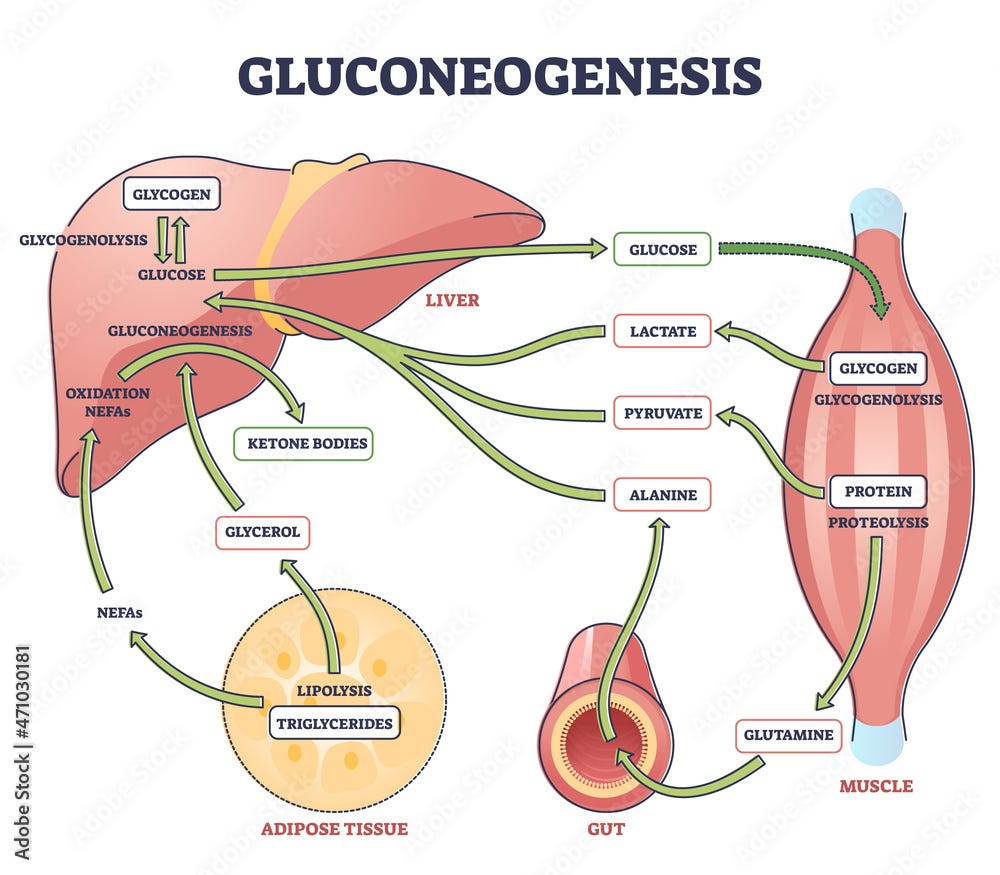
While it does this, it also blocks the cell from burning glucose well, so the sugar it just manufactured stays in the blood instead of being used. You end up with high blood sugar yet still being starved for fuel, having paid for it through your own tissue.
This doesn’t even require very extreme levels of stress, ordinary levels also drive harm. Cortisol switches on a catabolic program inside the muscle cell and tags your own protein for disassembly (Waddell 2008, PMID 18612045; Shimizu 2011, PMID 21284984).
In essence, cortisol is the hormone that ‘borrows’ energy when you have no good source of it. It does its job well, so you stay upright and get through the week. But you do not borrow for free. Every gram of glucose through this path used to be bone, muscle or immune tissue a moment before, and the actual process is stressful to your body in many other ways.
The cells understand this. If you give a white blood cell enough glucose, it switches cortisol off inside itself, inactivating the active hormone the moment its own fuel is secure.
So when fuel is present, the body powers the catabolic signal down, because the signal was a response to fuel running short in the first place. Glucose sufficiency is a cellular defense against cortisol.
Chronically high cortisol is a readout of an energy and nutrient deficit, and it breaks the body down in proportion to how long the deficit runs. The lever, then, is upstream.
You remove the shortage by feeding the system, repair what it is short on, and let the borrowing stop. What you are aiming for is a cortisol that rises and falls on a healthy rhythm, as it was designed to do.
A short, free quiz about which way your own stress chemistry tends to run and what it means:
metabolicblueprint.io/quiz
2. The Stress Response, Fast and Slow
Cortisol does not work alone. It runs as the second, slower half of a two-part system, and you need both halves to understand it properly.
A stress response runs both short- and long-term. The fast lever is adrenaline and the nerves that fire with it.
When a demand lands right now, adrenaline answers in seconds. It pulls sugar out of the liver, speeds the heart, and pushes fuel into the blood faster than any hormone could, then it clears just as fast. It covers the short-term gap, for the second the body needs a jolt of energy.
The slow lever is cortisol. Cortisol covers the stretch of hours and days when the energy shortfall is present. It raises blood sugar by catabolizing the body, and it keeps being high as long as the demand outruns the supply.
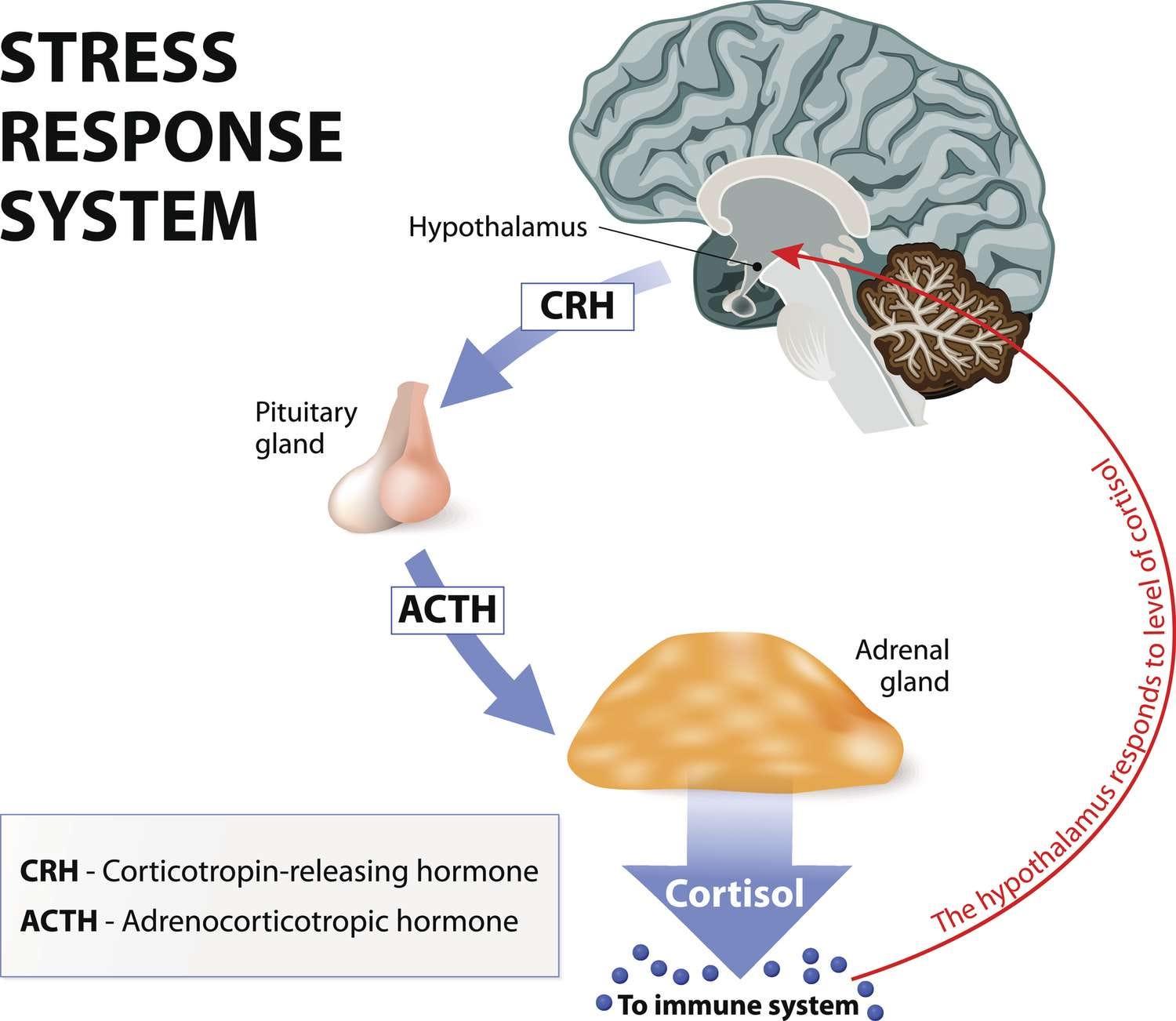
Both levers do the job of mobilizing fuel, just on different timescales. But they both are the answer for when the metabolism cannot fund what the body requires.
This is why a stressed person can feel so wired yet tired at the same time. The wired aspect is the adrenaline, a nervous system being too switched one, and the tired part is the body underneath, the one that has been propped up on borrowed fuel because it could not make enough of its own.
A calm, well-fuelled body does not need to run its stress axis heavily. The body that feels weirdly locked-in and exhausted together is showing you a low-fuel engine held upright by stress chemistry.
A pulse that races when resting, sleep that does not recover you, and weird alertness that never becomes calm, are all readable signals about which state you’re in, and learning to read your own state is its own subject.
Carbs and salt lower the need for adrenaline.
Broda Barnes saw the clinical version of this and built a rule around it, where the anxious, low-metabolism person is usually under-fuelled, not over-stimulated, and the nervousness is the sign of a body running on emergency chemistry.
The exact mechanism, how salt and sugar pull adrenaline down, comes later. For now, know that you quiet the stress arms by feeding the body.
For completeness, know that an acute stress response has its time and place. The fast, contained jolt of adrenaline and the sharp morning rise of cortisol are how a working body meets a real demand, and a body that could not mount them would be in trouble. When we speak about stress, we’re naming the chronic version, the catabolic state that sets in when the borrowing never stops, when the stress hormones run hot every day and tax the body over months.
3. The Night Waking
You fall asleep fine, then you wake up with a pounding heart at night. Odd alertness and feeling weirdly hot.
This is the clearest output of a system that is stress biased, and the fastest one to fix.
Your liver holds a tank of stored sugar, roughly 80 to 120 grams of glycogen, and that tank is what feeds your blood while you sleep and do not eat.
Overnight, the tank drains.
For some people it runs low well before morning. When it does, blood sugar starts to fall, and the body will not allow that to happen (it heavily depends on glucose, low levels are life-threatening). Adrenaline and cortisol surge to raise your blood sugar, so you wake up anxious.
That’s your body rescuing you when metabolism couldn’t fund you properly.
The nightly rise in cortisol is supposed to happen, part of how you wake up in the morning. But even that ordinary, healthy-range rise does real work on your metabolism while you sleep. It tells the liver to pour out more glucose, and at the same time it tells the muscle to take up less of it.
Robert Dinneen and his colleagues showed this directly. They held cortisol at the levels an ordinary stressful day produces, nothing extreme, and watched the liver’s glucose output climb while the muscle’s fuel uptake fell (Dinneen 1993, PMID 8227343).
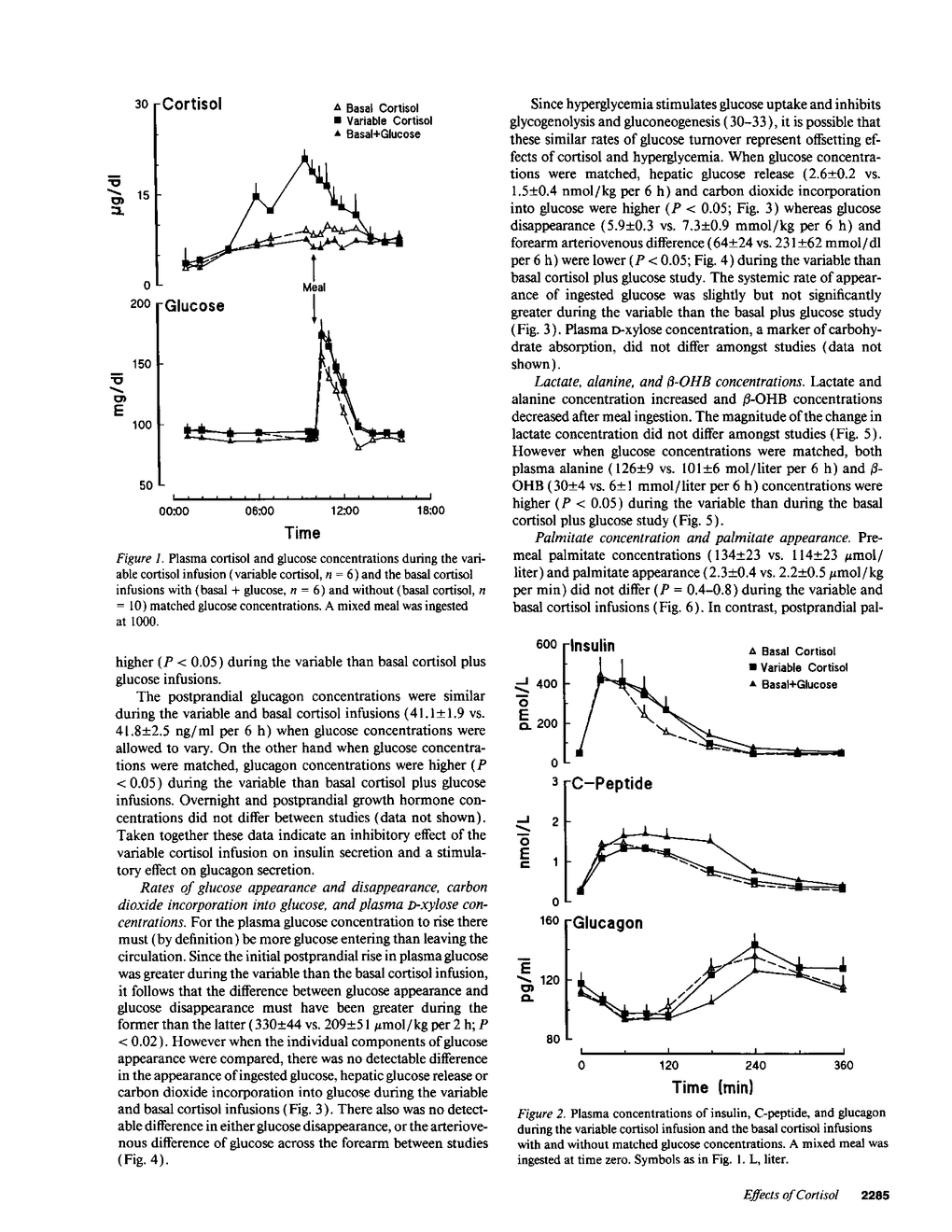
Stress-range cortisol, the amount a normal hard day or a short night can produce, is already leaving you a little insulin-resistant by morning. That’s a precursor to a lot of diseases.
You can see why the fix has to be a feeding fix. The waking is a fuel problem dressed up as a nerves problem.
Telling a body short on fuel to relax and to not stress, does not refill the tank. The lever is upstream, you give the liver enough to get through the night, so it never has to call adrenaline and cortisol in to rescue you.
Feed the system and the rescue is not needed.
The exact way to do that, what to eat and when so the tank lasts until morning, is its own short protocol, and it comes later. The point is that waking up at night is likely a fuel issue, and is easily fixable. Just this alone can majorly improve your life quality.
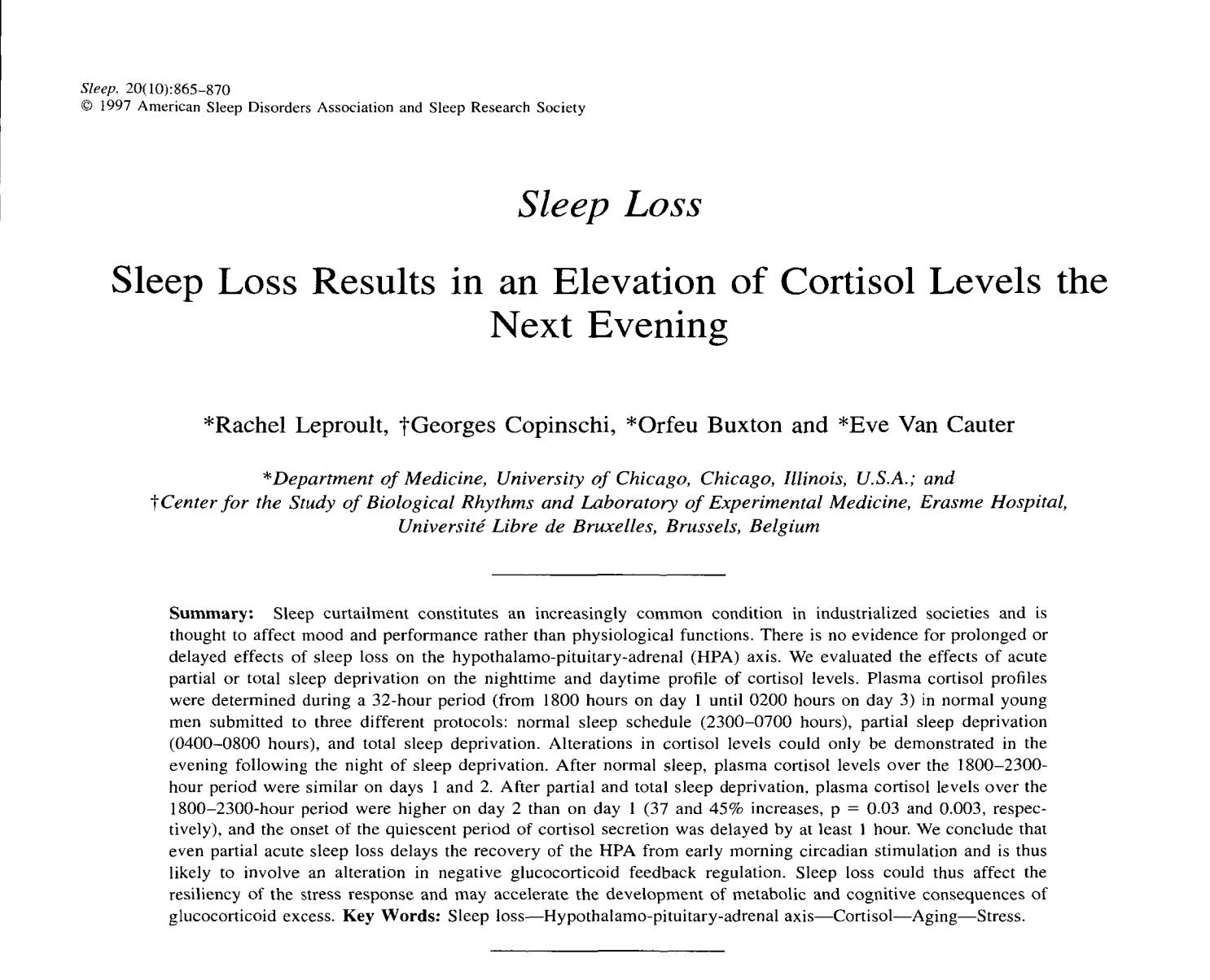
Losing sleep raises the next evening’s cortisol, so a string of short nights nudges the whole rhythm upward and makes the following day a little more expensive to run (Leproult 1997, PMID 9415946).
If you keep waking up at night, you are likely somewhere on this map. Take the quiz to learn more about your state:
metabolicblueprint.io/quiz
4. The Bill, Part I: The Structural Cost
So what are the costs of being stress biased? How dies it affect you?
We will walk the three organs that carry the structural cost, the tissue you stand and think with. Muscle, bone, brain.
Muscle: the strength goes before the size
The catabolic program that consumes your own body turns on with cortisol. It costs you strength before it costs you size.
The first fibers it comes for are the fast, powerful ones, the ones that produce strength. So your strength can drop while the muscle still looks the same in the mirror and weighs the same on a scan.
Weakness shows up in the large muscles closest to the trunk, the hips and shoulders, and it is out of proportion to any visible loss of mass (Sato 2017, PMID 28359087).
The usual blood marker of muscle damage, creatine kinase, comes back normal, because the muscle is not being injured, rather being disassembled.
Measured directly, people on long-term cortisol-type medication had over twenty percent less strength in the thigh, with the muscle area shrunk by a similar amount (Horber 1985, PMID 3998075).
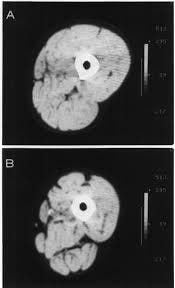
This can show up as a worse workout, more fatigue for normal day-to-day work, and less control of yourself. That is force leaving ahead of mass. None of this is an exact instrument, and a single heavy session means nothing, but a stretch of them at loads that used to be easy is your muscle telling you it is being borrowed against.
But strength is trainable straight back. People on long-term cortisol medication who trained for fifty days normalized the strength they had lost, and those on higher doses had the most to gain from training (Horber 1985, PMID 3998075).
The lesion is the body shutting down construction and running disassembly, and both of those reverse when you remove the load and rebuild. Cortisol takes strength first, and training is how you take it back.
Bone: the fractures
Cortisol can fracture a bone whose density looks normal.
Cortisol does not mainly strip the mineral out of bone but suppresses the cells that build bone and it kills the living cells inside it, the osteocytes, leaving a skeleton that still has its mineral but has lost its quality and its repair (Van Staa 2003, PMID 14613287).
A bone is living, maintained tissue, and cortisol stops the maintenance. So the density scan, which only counts mineral, can look fine while the bone underneath has become brittle.
You can see the mechanism confirmed in how the drugs perform. When bone is failing this way, the medication that builds new bone outperforms the one that only stops bone from being lost (Saag 2007, PMID 18003959).
That result only makes sense if the core problem is suppressed building rather than excess stripping, which is exactly what cortisol does.
And bone does much of its building in the dark, on a nightly rhythm. Cortisol rising in the evening abolishes that night’s bone-building, shutting down the formation that was meant to happen while you slept (Nielsen 1988, PMID 3263379).
The same evening shift that taxes your metabolism overnight is also cancelling the night’s repair of your skeleton.
In people whose bodies were overproducing cortisol, removing the source cut the rate of new spinal fractures from roughly half of them to under one in ten (Salcuni 2016, PMID 26630908).
Take the cortisol away and the bone rebuilds.
Brain: the neuron is starved
Cortisol’s cost to the brain is, at its root, the same energy problem as everything else in this book. It starves the neurons and leaves it less able to hold its energy up under any further demand (Sapolsky 1986, PMID 3746406).
A starved neuron is a fragile neuron.
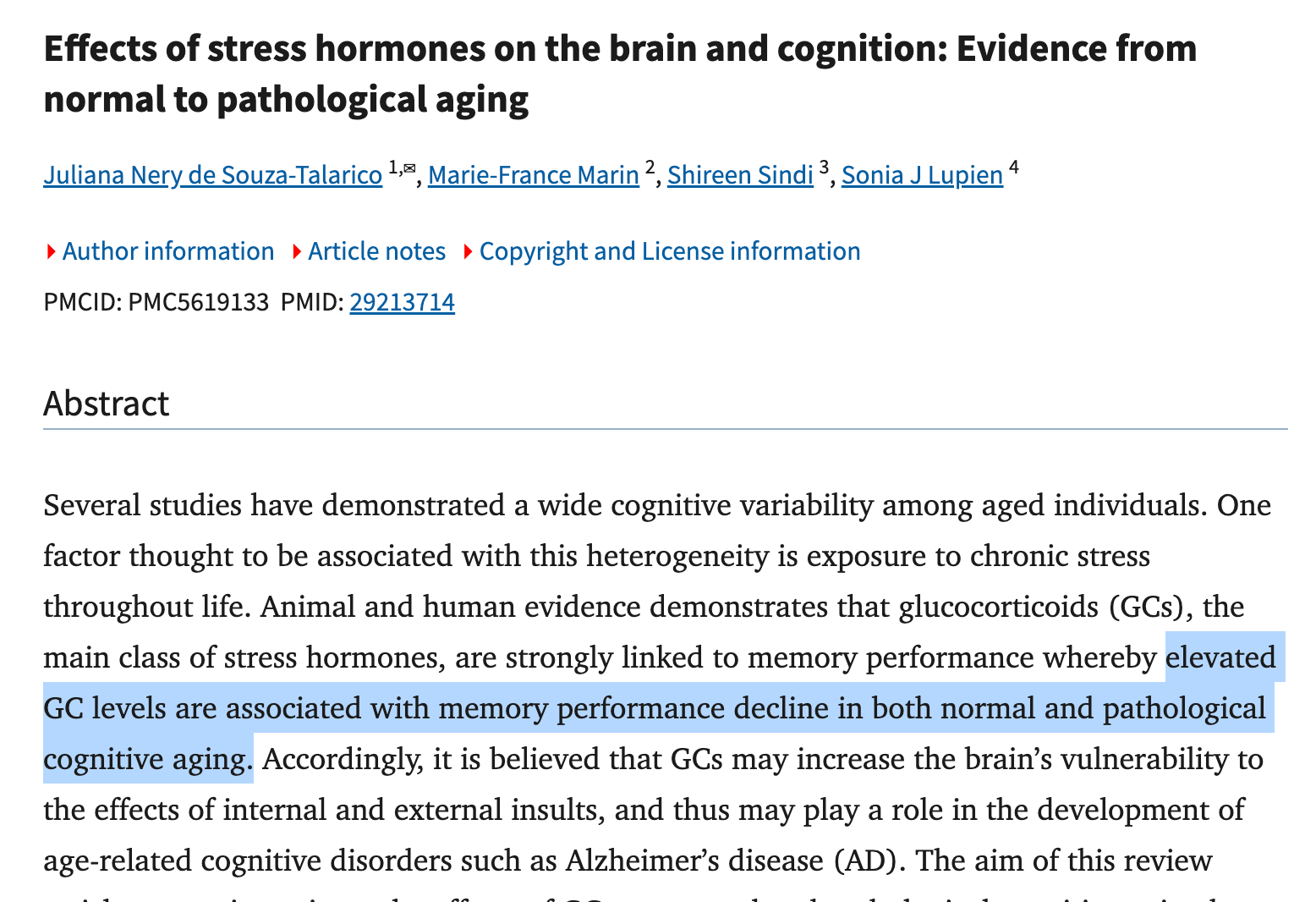
The same studies that showed that the neurons were endangered, showed the endangered neurons were rescued by supplying them energy.
The brain under cortisol stress is short on fuel, and fuel is what protects it.
The effect runs on a curve, and that changes what you do with it. A little cortisol sharpens the brain while too much dulls it (which is the modern standard).
When people with long-standing cortisol excess had it corrected, the hippocampus, the memory structure cortisol wears down hardest, regrew, by up to around ten percent. Memory recovered alongside (Starkman 1999, PMID 10624540).
Not everything reverses, and the deepest, longest exposures leave a partial mark in the body, but regrowth is possible when the borrowing stops.
Cortisol takes the strength from your muscle, the building from your bone, the fuel from your neurons.
5. The Bill, Part II: Surface, Sleep, Fat, and Heart
The bill of cortisol shows up even at ordinary stress levels, not just disease or exceptional cases.
Hold cortisol at the level an ordinary stressful day produces, and whole-body protein breakdown rises while insulin and glucagon sit unchanged, the catabolism running on cortisol alone (Simmons 1984, PMID 6365973).
Hold it longer and protein breakdown climbs about fifteen percent (Darmaun 1988, PMID 3048115).
Infuse cortisol for three days and urinary nitrogen loss doubles by day three (Gelfand 1984, PMID 6511925). That is your own body leaving in the urine.
Stress-range cortisol, the kind a hard week or a string of short nights makes, does significant catabolic work.
Now the rest of the systems.
Cortisol face is real, and it is three separate things.
Cortisol thins your skin by stopping its construction.
It represses collagen synthesis directly, and collagen is about seventy percent of skin’s dry weight, so the structure goes when the making stops.
Even a low inhaled dose suppresses skin collagen synthesis fast, with new collagen falling 39 to 63% within six weeks (Autio 1996, PMID 8630563).
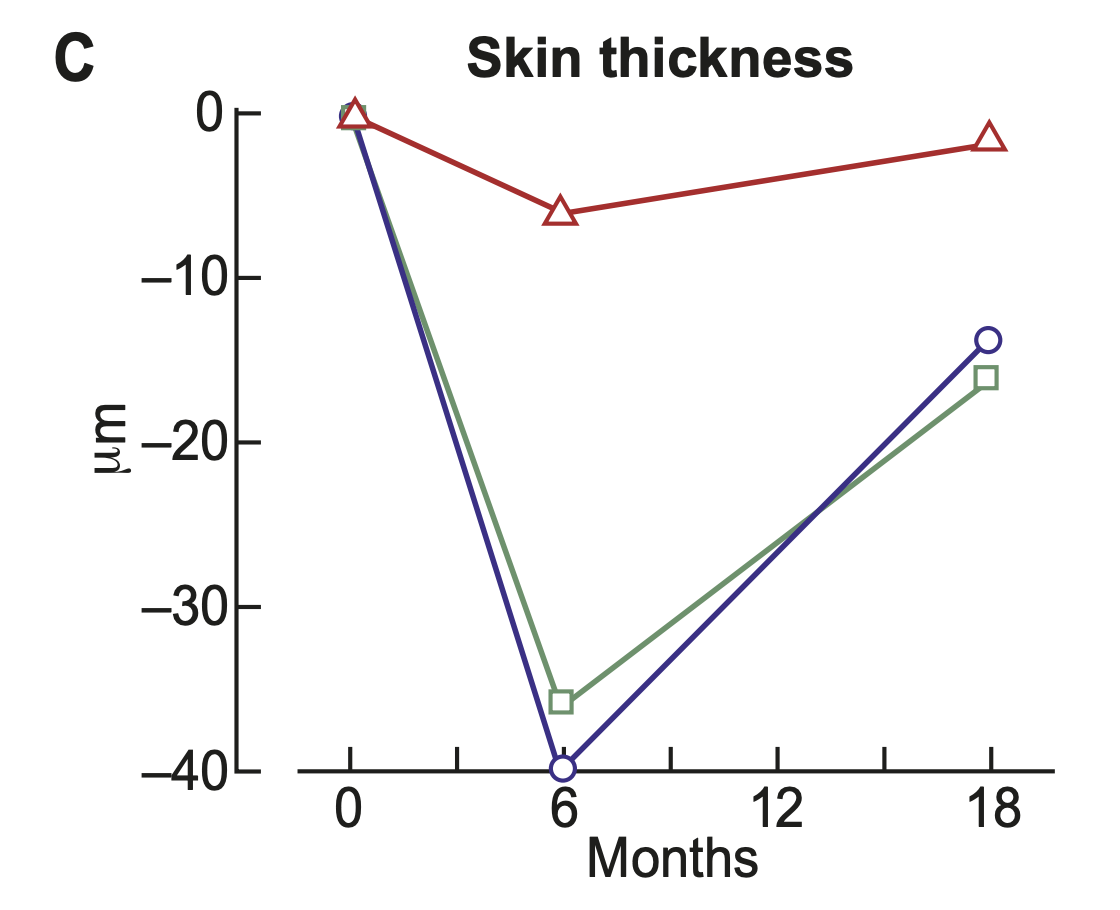
At higher exposure the skin thins and bruises easily, the classic signs of cortisol excess (Nieman 2015, PMID 26156970).
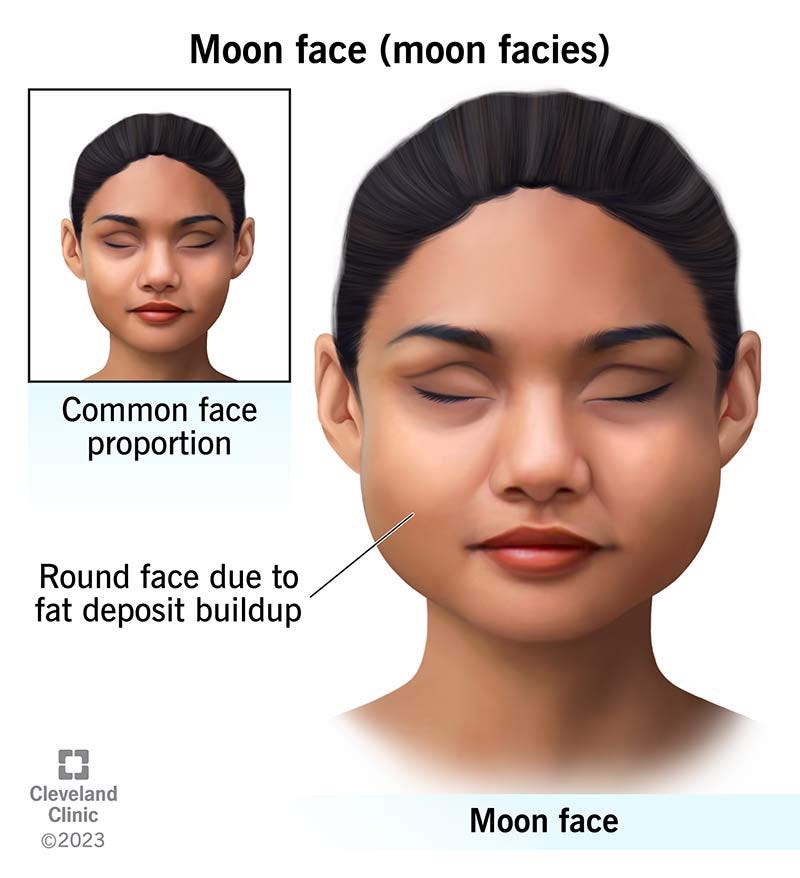
There’s also roundness in the face, or “moon face”.
Cortisol moves fat off the limbs and to the trunk and face, so the cheeks fill while the arms thin (Stimson 2017, PMID 28177189).
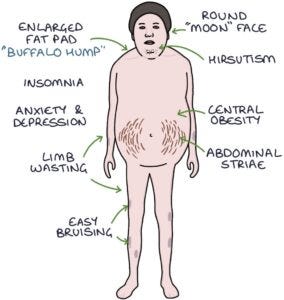
A third factor is water retention.
The puffy, rounder face under chronic stress is anti-collagen thinning plus a specific fat distribution and water retention.
It largely reverses within a year or two once the source of excess cortisol comes off.
Sleep: the night’s repair runs on the cortisol fall
Cortisol and sleep are wired together, and a good night needs cortisol to be low.
The hormone is built to fall through the evening and bottom out overnight, and that low is part of what lets deep, slow-wave sleep do its repair.
More on sleep in my other article, the complete guide to fixing sleep:

The slow-wave window (deep sleep) is when the stress axis is actively turned down (Bierwolf 1997, PMID 9229358).
When the rhythm is right, the two hold each other in place. Cortisol falls so sleep can deepen, and deep sleep keeps cortisol down.
Chronic stress breaks that rhythm at the wrong end of the day. Cortisol stays up at night instead of falling, REM is held down, and the wind-down that deep sleep is meant to bring never fully arrives (Friess 2004, PMID 14647485).
The night stops restoring you, even after the usual hours in bed.
Depth is the part that pays you back, and it pays in metabolism. Cut slow-wave sleep without shortening the night at all, and insulin sensitivity drops proportionally to the deep sleep lost (Tasali 2008, PMID 18172212).
How restored you feel is set by how deep the night went, not only how long.
Fat cells
Fat tissue makes its own cortisol.
An enzyme inside fat, 11-beta-HSD1, regenerates active cortisol from its inactive form on site, so a fat cell can run a high local cortisol while the blood reads normal.
Raise that enzyme in fat alone, to the levels obese humans carry, and the animal grows the full metabolic syndrome, visceral fat, insulin-resistant diabetes, dyslipidemia, salt-sensitive high blood pressure, with circulating cortisol never elevated (Masuzaki 2001, PMID 11739957).
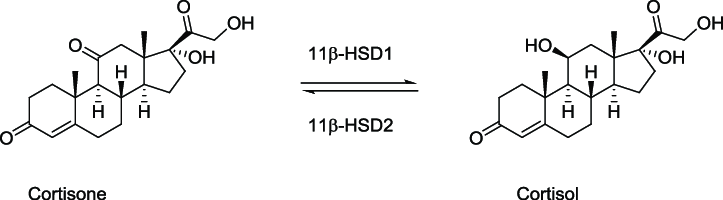
This is crucial to your metabolic state, and you do not want high local cortisol. It’s invisible to labs, yet it leads to devastating results.
In men, the body’s own cortisol output tracks visceral fat and insulin resistance specifically (Purnell 2009, PMID 19050176).
A normal cortisol result on a blood test does not clear you. The blood cannot see the amplifier in the tissue.
The immune system takes a massive hit too.
Chronic cortisol redistributes and suppresses immune surveillance.
It moves white cells out of circulation and powers down the cells that patrol for infection and damaged tissue.
Long-term cortisol-type medication raises serious infection risk by dose, and the risk is measurable even at five milligrams a day or less of prednisone (George 2020, PMID 32956604).
A flattened daily cortisol curve, with higher levels in the evening, tracked with worse cancer survival in one prospective cohort, read as failed surveillance (Sephton 2000, PMID 10861311).
A normal amount of cortisol is required for a fit immune system, so the loss belongs to chronic excess, and removing the excess restores a healthy state.
Water retention and puffiness
Cortisol can act on the receptor that holds onto salt and water, the mineralocorticoid receptor.
The kidney normally protects that receptor with an enzyme, 11-beta-HSD2, that breaks cortisol down before it reaches it. When cortisol runs high, that guard is overwhelmed, cortisol spills onto the receptor, and the body retains sodium and water.
The result is higher blood pressure and a heavier fluid load, the same arm that puffs the face above. The damage builds over time.
Cortisol affects the body in an extremely wide range of ways. Reducing excess cortisol is one of the most beneficial things one can do. First, we need to understand the REASON cortisol runs high, the circuit between low metabolism and high cortisol, where each one keeps the other elevated.
6. Thyroid and Cortisol
So why does cortisol run high and stay high?
Cortisol is locked in a loop with a slow metabolism, and each side keeps the other where it is.
Cortisol breaks your metabolism (thyroid health) in two places.
Centrally, cortisol turns down the brain’s signals to the thyroid, so less signal goes out to make hormone in the first place.
An ordinary dose, nothing extreme, cuts the daytime thyroid signal by around 40% (Samuels 2000, PMID 10770171).
In the rest of the body, cortisol blocks the step that turns storage thyroid hormone (T4) into the active form (T3), and shunts it toward the inert reverse form instead (reverse T3).
So even the hormone you already have gets converted away from the version that does the work (Banos 1979, PMID 233400).
A slow thyroid clears cortisol slowly.
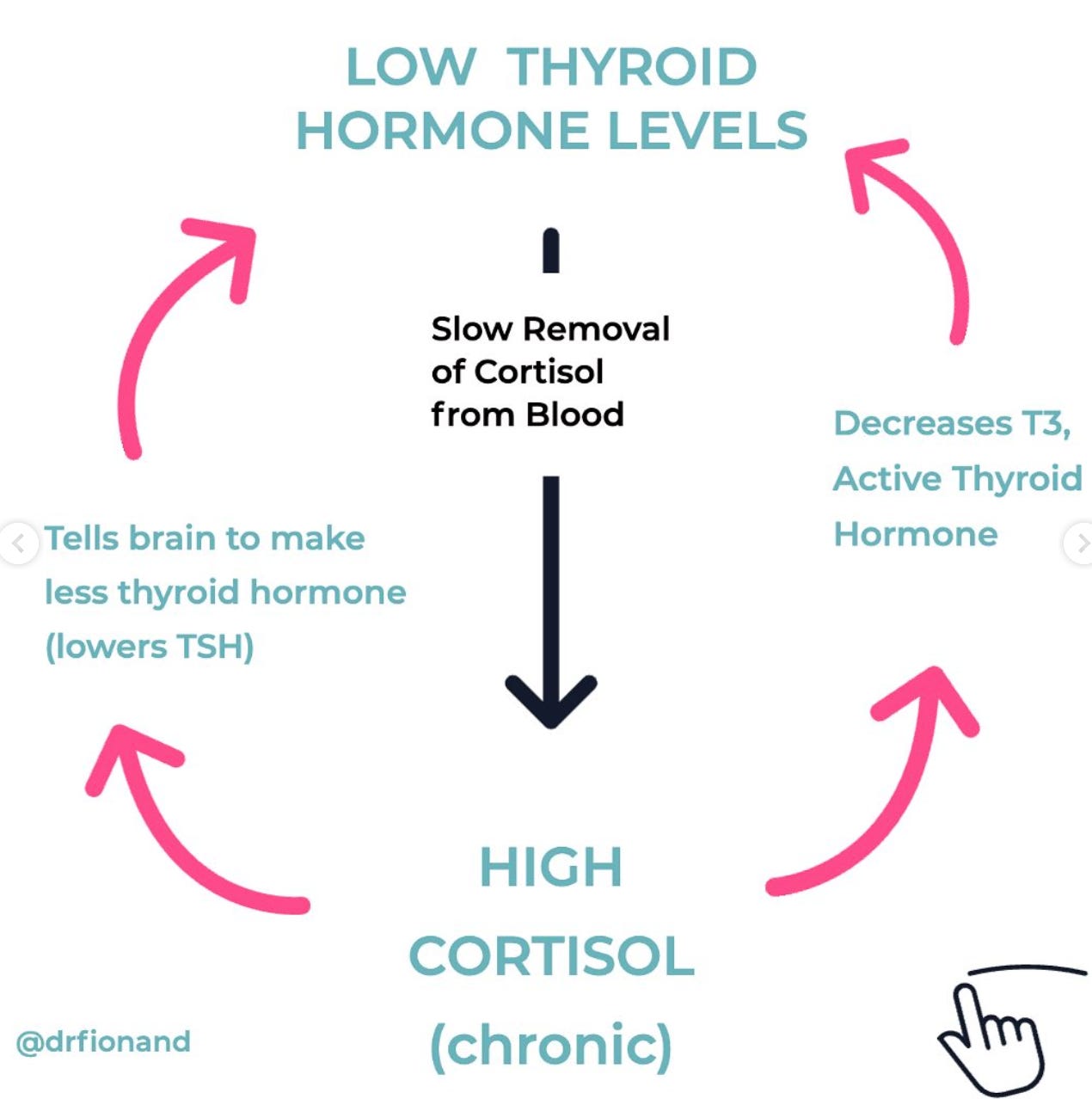
The active hormone is broken down based on how strong the thyroid output is. When it’s low, that breakdown reduces.
In low-thyroid states cortisol’s half-life nearly doubles, roughly 155 minutes against 73, so the same amount of cortisol lingers far longer before it is cleared.
The person carries elevated cortisol around the clock with the adrenal glands working a perfectly normal amount, and it reverses when the thyroid is restored (Iranmanesh 1990, PMID 2294128).
So the circuit runs in both directions. A low, slow metabolism clears cortisol poorly, which keeps cortisol high. High cortisol brakes the thyroid, which keeps the metabolism low.
Each turn deepens the other, and the body settles into a state where high cortisol and low metabolism are holding each other in place.
You can see the loop on a face.
The puffiness and rounding from the last section, the “moon face” people associate with thyroid trouble, is partly this clearance.
A hypothyroid or Hashimoto’s person clears cortisol slowly, so they carry more effective cortisol without the body doing anything extra to produce it. That added cortisol feeds the same facial fullness already described, sitting on top of the fluid the low thyroid retains on its own (myxedema).
High cortisol is not only a cost you pay, it is also a cause that holds the slow metabolism down that produced it in the first place.
A loop is self-reinforcing, which is why it feels stuck. But a loop also has a place you can break it.
Lift the metabolism and the body clears cortisol faster, and the cortisol that was braking the thyroid eases off.
The same move that frees the thyroid lowers the cortisol, which is exactly why the way out begins by feeding and restoring the metabolism, the lever that breaks both sides of the loop at the same time.
How you actually do that is what comes next.
7. Rhythm Beats Level
Getting your cortisol checked with labs is very variable and often not very useful. It’s often in range and you’re told you’re fine, yet your levels can be very suboptimal and harmful.
Cortisol is meant to move across the day. A healthy day has a sharp rise in the morning that gets you up and going, then a long fall through the afternoon and evening, down to almost nothing by the time you sleep. That faaling is a signal, and the shape of the day is what determines if it costs you.
The harm tracks the SHAPE, not the height.
A flat day, where cortisol never really rises in the morning and never really drops at night, is what lines up with worse outcomes. The morning number on its own, and the size of the morning rise on its own, predict almost nothing about your health (Adam 2017, PMID 28578301; Kumari 2011, PMID 21346074).
A person whose cortisol stays up into the evening, who has lost the nightly descent, is the person whose body is struggling.
The pattern carries more weight than the amount because the body reads timing, not totals. Give an animal the exact same daily dose of cortisol, but deliver it in proper pulses versus a flat drip, and the two switch on different sets of genes (Stavreva 2009, PMID 19684579). It’s the same quantity but ends up in different instructions, as the rhythm is just as (if not more) important than the total amount. So the ideal state is a clean shape, not the lowest possible cortisol. You want a strong morning peak and a protected evening fall.
The morning side of that curve, how light first thing in the day builds the peak, I cover in The Sun Bible:
Do Not Fear The Sun (Full Sun Guide)

There is a kind of person who always wears sunscreen before leaving the house.
Now the harder correction.
A single blood test cannot see two things, and both of them are very significant.
The first is the tissue amplifier. As covered earlier, your fat and other cells regenerate their own active cortisol on site, so the local exposure inside the tissue can run high while the blood reads completely normal. The blood test cannot see that.
The second is the binding problem. Most of the cortisol in your blood is bound, stuck to a carrier protein that holds it inactive, and only the small free fraction can actually do anything. So the “total cortisol” your test reports is mostly the bound, inert pool, and that number moves up and down for reasons that have nothing to do with stress (Lund 2019, PMID 31161807).
How much of that carrier protein you happen to make is set largely by your genes, which is why two equally calm people can post very different total numbers (the CORNET work on the SERPINA6 gene, PMID 33469137).
The cleanest example of how badly this misleads is the birth control pill.
Oral estrogen, including the pill, tells the liver to make far more of that carrier protein. With more carrier in the blood, total cortisol roughly DOUBLES. The free, active fraction barely moves. So a woman on the pill can get a blood test back showing “high cortisol” that measures her binding protein, not her stress. (Estrogen applied through the skin skips the liver’s first pass and does not do this, which is part of why the route makes a difference, Kaminski 2021, PMID 34183565.)
When the body’s regeneration of its own cortisol was measured directly, a low-carb diet raised that on-site production while the cortisol in the blood stayed flat (Stimson 2007, PMID 17785367).
So where does this leave testing?
The instinct behind the saliva panels and the multi-point rhythm kits is directionally right. The shape of the day does carry more weight than a single level, and a panel that samples across the day is at least looking at the right thing. But reading a panel as a precise scorecard, a stack of numbers to chase one by one, over-reads what it can tell you. Only the pattern is truly useful for you here.
Which is the whole point of this section. A normal cortisol number does not clear you. It can be normal while the amplifier in your tissue runs hot, and it can be high for a reason as ordinary as a pill that has nothing to do with stress. The number is doubly blind by design.
That leaves a real question.
How do you actually know what your cortisol is doing inside your body?
8. The Protective Side
Cortisol does not act alone in the body. The body builds it from the same raw cholesterol as a handful of other steroids, and the same tissues that read cortisol read them too.
Some of those steroids push the opposite way. They sit on cortisol’s receptors, blunt its message, and tilt the body back toward building instead of breaking down.
Think of cortisol as a fraction, cortisol being on top divided by the opposing steroids underneath. The ratio between them is what the tissue actually feels.
You can fight all day to shrink the top, you can also rebuild the bottom. The same blood that carries cortisol carries these, and when the bottom falls, cortisol wins by default even if its own level never moved.
Three steroids on the protective side are worth knowing deeply.
Progesterone
Progesterone sits ON the cortisol receptor. It binds the same place as cortisol without switching the receptor on, which makes it a true competitive blocker of that receptor (Rousseau 1972, PMID 4402888).
Progesterone is a weak blocker, its affinity on the receptor is about 1/5th of cortisol’s own (Reichardt 2004/2005).
Its cortisol-blunting is powerful where progesterone greatly outnumbers cortisol, such as the luteal half of a woman’s cycle, pregnancy, or a deliberate high dose. In a man, and at other levels, that competition is mostly a gap in the evidence rather than a proven effect, and whatever calming does come through is partly the work of its quieting metabolite, allopregnanolone.
So as a direct blocker of the cortisol receptor, progesterone is partial at best, strongest in the female luteal and pregnancy window, not a master cortisol-blocker.
What progesterone reliably does for stress is calm the brain, and it does so through a metabolite called allopregnanolone. Allopregnanolone is a calming metabolite, producing deeper sleep and restoration. This reaches men as much as women, where a single nighttime dose deepened non-REM sleep in healthy men (Friess 1997, PMID 9176190), and oral progesterone produces measurable relaxation that tracks the rise in allopregnanolone (van Broekhoven 2006, PMID 17034954).
That calm is also how progesterone lowers cortisol. The same GABA brake settles the CRH neurons that set the whole stress axis going, so the brain sends less of the signal that makes cortisol in the first place. In women in the luteal phase, when allopregnanolone is high, the night’s cortisol runs significantly lower (Segebladh 2013, PMID 23329007).
The metabolite is real enough that drug versions of it, brexanolone and zuranolone, are FDA-approved (Kanes 2017, PMID 28619476). In essence, progesterone is pro-calm and pro-sleep, and it’s powerful.
DHEA: cortisol’s counterweight
DHEA is the most abundant steroid the adrenal makes, and it is cortisol’s natural counterweight, the anti-stress androgen your own body builds to oppose the catabolic side.
When you raise it, cortisol can come down. In a controlled trial a high dose of DHEA lowered twenty-four-hour cortisol, most durably in women (Kroboth 2003, PMID 12544381).
DHEA also pushes the other way inside the tissues, blocking the enzyme that regenerates active cortisol on site, the same local amplifier from earlier.
Cortisol-to-DHEA-S ratio is a useful readout of where your protective side stands, because it catches what cortisol measured alone misses. In one large follow-up of veterans, that ratio predicted all-cause and cancer death over the years ahead where cortisol alone, after full adjustment, did not (Phillips 2010, PMID 20498139). Critical illness shows the extreme version where cortisol climbs while DHEA-S collapses, and the widening gap marks the sickest patients (Arlt 2006, PMID 16608898).
DHEA falls steeply when aging, while cortisol tends to stay flat or even higher. A low DHEA is best read as a gauge of how far the protective side has fallen.
Testosterone: the anti-catabolic hormone
Testosterone works against cortisol where the structural cost from earlier is worst, in muscle. Muscle is dense with cortisol receptors and feels every catabolic effect cortisol sends, and testosterone pulls the same tissue the other way, tilting it from breakdown toward building.
In older men running low, restoring testosterone raised lean mass and grip strength (Page 2005, PMID 15572415). Part of what testosterone does in muscle is push back on the catabolic, cortisol-dominated state.
Aging is a ratio collapse
Put the three together, you start to see the pattern of aging and chronic stress. Progesterone, DHEA, and testosterone all fall. Early in life, cortisol holds roughly steady, so the early problems usually are a lost defense. The trouble is less a flood of cortisol than the loss of the steroids that used to stand against it.
These steroids are built by a well-fueled, well-lit, well-rested body, so the lever is to feed it, to get morning light, and to protect sleep, the conditions under which the body tends to rebuild its own supply.
Sunlight in particular supports the protective steroids, including progesterone and testosterone, which I cover in The Sun Bible.
Using these steroids as deliberate levers, and any dosing, is a later subject, but the first move is to rebuild the body that makes these steroids, and the supply follows.
9. Reading Your Own State
You now know that waking up at night is often an empty tank, and the body reaching for stress chemistry. I’ve observed this pattern in dozens of clients.
This section teaches the rest, so you can read, without a lab, whether you are likely running on borrowed stress chemistry, and so you can watch that borrowing recede as you start to repay it.
The day has a shape you can feel
A healthy cortisol day has a shape at both ends, and you can feel it. In the morning you wake with some lift, some ‘healthy stress’. You warm up and come online over the first hour, you get hungry in a normal way, and you can meet the day properly. In the evening the drive drops properly, so the body settles and you get sleepy on time to let go. Up in the morning, down at night.
The borrowing shows up as the loss of that shape, and it arrives in one of two ways. The first is flat all day with no real morning lift, no real evening drop, the worst of both worlds where you are too tired to perform, too wired to relax. This leads to a truly muddied lifestyle.
The second, more interesting one I’ve observed, is the second wind of energy at night, where you’re dragging through the whole day, then a surge of clarity and energy late in the evening, most awake exactly when the body should be powering down. That 11 p.m. burst of “finally I can work” is the evening descent failing to happen, and it feeds straight into improper waking. A sharp morning rise is the goal here.
The felt signs of borrowing
Each of these is a downstream consequence you can feel of excess stress dependence.
The most important sign is the wired-and-tired feeling we discussed earlier. Exhausted yet unable to switch off in the same body. The tiredness is the real fuel deficit and the wiredness is the stress chemistry recruited to cover it, a backup generator that keeps you on and will not let you rest.
In chronic insomnia, all-night blood sampling has shown 24-hour activation of the stress axis, with the largest elevations in the evening and first half of the night, exactly where a healthy rhythm should have its lowest stress state (Vgontzas 2001, PMID 11502812).
A racing or pounding rest pulse often shows up here too. Adrenaline drives the heart while the underlying metabolism conserves, so the pulse runs high even when nothing is happening. Reading your pulse alongside your temperature is its own instrument and its own subject. For now, take the unsettled rest pulse as one stress signal among the pattern.
Sleep that does not restore is another. Depth, not hours, determines how well you repair. A night partly defended by stress chemistry does not repair as well, and a broken night raises the next evening’s stress, so you slide into a self-feeding loop where you never quite catch up. We will go into how to break the loop, but The Sleep Bible covers this topic in depth for sleep specifically.
Waking up at night is common. When the overnight tank runs dry, the body borrows to refill it, and the ravenous night hunger is that borrowing made conscious.
A strange unsettled alertness, edgy and anxious when you would rather be calm, is the daytime version of the same hyperarousal. For example, a magnesium-drained system overreacts, making the stress signal too easy to produce and slower to clear.
Appetite is a huge tell as well, with salt/sugar cravings and night hunger being the clearest signs. Salt tracks more of adrenaline responses, sugar and night hunger track the liver running short of stored fuel. The body is asking for the substrate that would let it stop borrowing.
Cold hands and feet can show up as one felt sign that the metabolism is conserving, though that one leans more thyroid than cortisol (though they are intimately connected).
Mood can run flat but edgy, an anxious, fatigued feeling.
Read the pattern, not one single sign
Every single sign can have an innocent cause. A racing pulse can be coffee or a hot room, waking at night can be a full bladder or early sun, a bad night can be a bad mattress and a one-off, cold hands can be the weather, a salt craving can be a sweaty workout, a flat mood can be a bad week.
Read any one alone and you can talk yourself into or out of anything. The signs earn their meaning only together.
“Fatigue is everywhere, so how do I know it’s cortisol?”
You know it because the borrowing is interpretable as a set of patterns. The clearest trio is being wired-and-tired, with an unsettled rest pulse, plus the night waking. When all three sit together, it’s very likely stress. Other clusters are non-restorative sleep with a morning that isn’t energetic, and salt+sugar cravings while also waking at night.
The most important question then is, does my day have a shape, up in the morning and down at night?
Track the trend
A single day has so many variables, so you want to track trends. Read the same few signs the same way over weeks, while you change one input at a time, and the innocent one-offs average out while the real direction shows.
Are the nights getting longer and less broken? The night waking is the best first trend, often the first thing to improve in my clients.
Is the rest pulse settling down?
Are the mornings coming online faster?
Is the evening winding down on time, the second wind fading?
Is the wired-and-tired feeling separating back into ordinary tired, just tired when tired and calm when resting? Are the cravings easing? Read like against like, same time of day, and for anyone with a cycle, this week against the same week last cycle. One bad night inside an improving month is noise. A month of the same plateau is the signal.
You are reading for the signature of borrowing, the flat, stuck, wired pattern, not for the lowest and calmest and coldest version of yourself. Some cortisol rhythm is healthy, and the sharp morning rise is good. A day with a shape is the win. Feeling nothing, ever, cold and flat all day, is a different problem.
*This is a read for direction, not a diagnosis. Anything severe, escalating, or frightening, or a pounding pulse with chest pain or breathlessness, is a doctor’s question first.*
You can read the direction yourself now. What it cannot tell you is which lever to pull first, in what order, for your particular history and constraints.
That is the job of a Comprehensive Metabolic Analysis.
It’s your full situation turned into a comprehensive plan. To have yours mapped, start with the quiz at metabolicblueprint.io/quiz to see where you sit, or apply directly at metabolicblueprint.io.

What comes next?
The next half is what to actually change. It begins where the borrowing began, with the empty tank, which means it begins with feeding the body.
10. The Way Out, Part I: Feed First, and the Minerals That Make Fuel Usable
You lower cortisol by feeding the body. Cortisol is the borrowing, and the borrowing only stops when the system has enough to run on.
The one meta-analysis that asks what cortisol does when you pull substrate out found that cutting carbohydrate raises cortisol in men, modestly at rest and much more significantly when exerting, exactly when glucose demand spikes past what a depleted, fat-dependent system can deliver (Whittaker 2022, PMID 35254136).
Feed first
Sitting underneath the whole feeding tier is one variable, liver glycogen.
The liver holds only a small reservoir, and when it runs low, the body requires stress hormones. Keep the liver topped up across the day with enough good-quality carbohydrate and regular meals, so the body rarely has to borrow.
So the first lever is the plainest one. Eat enough carbohydrate, keep the fuel coming at regular intervals, and do not run the tank dry. This means a steady, healthy fuel supply.
In a controlled feeding study, the women who raised their carbohydrate most showed lower cortisol reactivity around a standard stress test, with the quality of the carbohydrate mattering as much as the amount (Soltani 2019, PMID 31652899). The benefit goes to anyone living in a fuel deficit, the chronic under-eater or the low-carber who feels wired and tired, because for them regular oxidizable fuel is the signal that the emergency is over.
A small, easy carbohydrate before bed lets the liver hold the line through the night, so it never has to call in adrenaline and cortisol to rescue blood sugar. Fructose is part of why it works, because fructose is routed preferentially into liver glycogen, which is the exact tank being defended overnight. In practice that means a carb-forward dinner plus something small at bedtime, a little honey, a piece of fruit, or a glass of milk with honey (my recommendation), where milk brings its own sugar along with protein and calcium to keep you anabolic and low-stress overnight.
Anyone on insulin or a glucose-lowering medication should set the timing and size of that bedtime carbohydrate with their clinician, since it changes overnight glucose control.
Someone always says low-carb fixed them, and they are often on to something. Low-carbohydrate eating does give some potential wins. It helps diabetes, fatty liver, and improves some blood work (largely due to their inability to properly burn sugar, which is a problem in and of itself, since metabolic inflexibility is not health). People run on it for years with no acute catastrophe. They often claim that the increased stress of low-carb diets normalizes over time, and point to a study showing that cortisol becomes normal after 3 weeks.
But it must be interpreted properly. A resting cortisol can come back to baseline two ways: you can restore the fuel, refill glycogen, and actually meet the demand cortisol was raised to cover, or you can lower the demand, lowering the metabolism that we’re actively trying to improve, until the body needs less glucose and the empty tank stops registering as an emergency. Low-carb takes the second road, and you can measure it, because cutting carbohydrate lowers active thyroid hormone, the body’s main way to increase fuel demand.
The normalized resting cortisol is sitting on top of a thyroid setpoint that has reduced, which looks more like a famine adaptation than a stress that resolved. And post-exercise cortisol stays increased long-term, so you are really losing performance here.
Low-carb genuinely helps specific people in specific states, but it’s a sharp and situational tool. A normalized resting cortisol on an empty tank is evidence the survival program switched on, not that health came back.
High-calorie malnutrition
Feeding is more than just eating more. A cell does not register the food on your plate, it registers the energy it can actually make, and those two numbers come apart whenever the path between them is blocked.
A low-fuel engine is set at the point of oxidation, by fuel burned, not fuel eaten. You can pour fuel into a tank where its usage is low, so the engine still starves. Abundant intake plus a blocked utilization gate is a functional energy deficit, hard to tell apart from true starvation at the level of cellular signalling.
Because the stress axis is built to defend the cell’s energy and listens to the mitochondrion rather than the plate, that functional deficit recruits the same borrowing, adrenaline then cortisol, as a real one. Abundance of eating, but scarcity in the cell.
This is why “just eat more” can fail even when eating well, and the person eating well yet still fatigued is not imagining it. Their problem was less about the amount of fuel than the utilization of it in their cells.
Three things jam it, and each has a way back.
The first is thiamine (B1), the quintessential metabolism nutrient, the cofactor that sits right on the gate of glucose oxidation. Its requirement goes with how much carbohydrate you burn (Sauberlich 1979, PMID 495541), and modern life is very insufficient in it. Seed oils, refined foods and things of that nature have either blocked our utilization of thiamine, or increased our demand for it. Get thiamine adequate as you add the carbohydrate and that arm of the gate swings open. This is one supplement that I genuinely believe most would benefit from, and is incredibly cheap.
I go in depth on it in The Thiamine Bible. Strongly recommend diving deeply into the nutrient.
The Thiamine Bible

People argue about carbs, insulin, cravings, ancestral diets, blood sugar, satiety, sugar highs and crashes. But there is one crucial question that must be asked before anything else.
The second is a membrane rich in seed oils. They increase the amount of peroxidation products (4-HNE) which inactivate the enzymes that start carb oxidation (Humphries and Szweda 1998, PMID 9843389), and bring a host of other issues too. Lowering how much seed oil you consume over the years improves this.
More in The Seed Oil Bible, everything about seed oils and PUFA.
The third is about half-burning glucose, where it stalls as lactate instead of fully becoming clean energy. The cell pulls a fraction of the power the meal should have given it. That is pseudohypoxia, a cell behaving as if it were suffocating while it sits in plenty of oxygen, because the gate to burn the fuel is shut (Lonsdale 2009, PMC2644268).
The felt result is the heavy, winded, low-stamina fatigue of oxygen debt, except at rest, and a cell stuck there keeps needing stress hormones.
So the fix tracks the diagnosis. A blocked gate recruits cortisol the way real starvation does, because the stress axis answers the cell’s energy, not the food on the plate, and the wired-and-tired you already know is that deficit read from the inside: tired because the cell cannot make energy, wired because the body has thrown adrenaline and cortisol at it. The move is to restore oxidizable fuel and give the cell the cofactors and the clean membrane that let it burn. Feed the body, then make the fuel usable, which is exactly the minerals next.
The minerals
These repair the gate and set the stress response. Every one is dosed by status, toward sufficiency.
Magnesium is the gain-setter. Adrenaline drains magnesium (Whyte 1987, PMID 3542342), and a magnesium-drained system then over-fires stress, where a provoked surge of stress hormones becomes exaggerated. Magnesium speeds the clearance of cortisol that has already been made, shifting it toward its inactive form, and long-term supplementation lowered that cortisol burden (Schutten 2021, PMID 33030273).
It also sits with thiamine at the oxidation gate, so it helps the carbohydrate you eat get burned. You become more efficient at recovering and burning. Massive ROI.
True magnesium sufficiency means a topped-up cell, which a normal blood test cannot confirm, because under one percent of the body’s magnesium is found in the blood, defended by the bone and the cell, so the serum reads fine while the tissue runs low (Workinger 2018, PMID 30200431). The supply is thin and the drains are many on top of that, as refining strips most of the magnesium out of food and never puts it back, while stress, caffeine, alcohol, and several common medications pull it out, the adrenaline drain hitting the wired hardest.
True sufficiency is much rarer than a lab suggests, which is exactly why repleting magnesium is a good move for almost anyone running hot. Dose toward sufficiency in divided amounts.
Glycine lowers cortisol through significantly improved sleep. Three grams within an hour of bed shortens the time to fall asleep and improves sleep quality (Bannai 2012, PMID 22293292). A body that sleeps deeply stops borrowing cortisol to get through the night. Separately, glycine is the corrective counter-signal to a muscle-meat-heavy diet, because a bloodstream loaded with the amino acids of lean muscle meat and short on glycine reads to the body like a catabolic-stress pattern, and gelatin, which is about a third glycine, rebalances it.
Salt is one of the most accessible anti-adrenaline levers there is, in adequacy. Running low on sodium forces the body to compensate with adrenaline, and restoring adequate salt relieves that compensation.
Sodium may also slow PNMT, the adrenaline-building enzyme. The relationship is a clean U-shape, because at the high-intake end the sign flips and loading raised urinary cortisol (Chen 2020, PMID 32511774). You want adequacy, salt to appetite with food, more for active people, heavy sweaters, low-carb transitions and the generally stressed person. Especially those who eat healthy, they often under-salt their food, from experience.
Thiamine is what makes carbohydrate an incredible fuel rather than a half-burned one, the cofactor sitting right on the gate of glucose oxidation, and the modern standard is having too little of it working. The shortfall is rarely about how much you eat. Average intake clears the basic requirement, but the gap is in demand. The average human is overfed on empty calories, relatively starved of the thing that burns them (Lonsdale 2009, PMC2644268).
Thiamine also hides on a lab. The clearest case is diabetes, where circulating thiamine runs roughly 75% low while the standard test reads normal, because the body masks the loss (Thornalley 2007, PMID 17676306). So get thiamine adequate as you add the carbohydrate, and the fuel oxidizes cleanly instead of backing up into the very deficit that recruits cortisol.
Vitamin C pulls cortisol down when cortisol is running high. In a trial, a gram a day for two months dropped cortisol in women with confirmed high cortisol (Beglaryan 2024, PMID 38010274). The effect lives in a small, concentrated adrenal pool that engages a stressed, dysregulated gland rather than capping a healthy one. Use it as target-engagement, a gram a day when cortisol is genuinely elevated, with a little more around hard, prolonged exercise to protect the recovery window.
The other micronutrients round it out, with larger effects when correcting deficiency. Zinc for example, when fixing a deficiency supported mood and the stress axis (Yosaee 2020, PMID 31837640), so dose it to status, watch the copper antagonism at chronic high doses.
Potassium is best understood as the co-mineral of the fed, glycogen-secured state, because refeeding carbohydrate drives it into the cells, so the simplest way to meet the need is the same fruit-forward eating that secures glycogen. Get it from food, orange juice and milk, never go above 10g a day, and it should improve how well you use fuel. Magnesium is potassium-sparing, so the two move together and repleting magnesium can itself raise potassium by reducing kidney losses.
11. The Way Out, Part II: Lifestyle and the Levers
The food refilled the tank and the minerals reopened the gate. This second half protects the rhythm the food restored.
Sleep depth, not hours
Deep, slow-wave sleep is where the stress axis quiets, so depth must be protected. Losing it carries a real cost, especially the metabolic damage from suppressing it even when total sleep stays the same (Tasali 2008).
The lever that buys depth is the same overnight fuel security from the feeding section, the carb-forward dinner and the small bedtime buffer. Sleep, blood sugar, cortisol, and thyroid are one overnight circuit, so you protect the depth by feeding the night.
Morning light, evening dark
The highest ROI lever you can pull is getting bright morning light, and keeping your nights dark. That builds the whole day’s amplitude from the right end. Get bright, outdoor light in the first hour after waking. Short-wavelength morning light raises the morning cortisol rise (Figueiro and Rea 2012, PMC3413982), which is crucial for a higher-amplitude day, and a sharp morning peak is the goal. Then dim and warm the lights in the evening so the body winds down. The worst curve you can build is dim days and bright nights, groggy in the morning and wired at night, which is exactly the shape of modern indoor life.
More on the morning-light anchor in The Sun Bible.
Training, dose and fuel it
Training is the one fully endorsed lever for insulin resistance, extremely effective, as muscle is where most of your glucose is disposed of, so we want properly dosed and recovered training. You don’t want to wreck yourself here, that just stresses the body out even more.
You must fuel the session for the greatest benefits. Post-exercise cortisol stays elevated when fuel is short, so carbs around training tilt a session toward building. I like having salted orange juice before and during training. Under-fueled hard training is itself a huge stressor, and we will get back to that.
The borrowed-energy sink
On a secure floor, each of the following things can be beneficial. The catch is that caffeine, fasting, cold exposure, heat, and hard training do not make new energy but are stressors in their own ways. The stressors stack, and the fasted, cold-shower, black-coffee, HIIT morning is three or four large stressors on the same body before breakfast, and because every one of them feels like discipline, one can delude themselves into thinking they’re doing a good thing. Secure the floor first, the glycogen and the sodium and the active thyroid, then spend from the sink, but do not stack these stressors when you do not have the capacity to.
If we take caffeine as our example, a usual dietary dose produces a stress-like cortisol rise in healthy people at rest, activating the stress axis with no real energy demand behind it (Lovallo 1996, PMID 8951977). The tolerance is partial, and so the cost does not disappear with multiple doses over time. The morning response does blunt in daily users, but the afternoon rise returns and is in fact the larger effect (Lovallo 2005, PMID 16204431). So time caffeine to the morning, keep the dose modest, and put glycogen and sodium under it first (avoid having it on an empty stomach).
The same lever yet opposite sign
Every one of these levers is state-conditional, and caffeine is the cleanest example. The same dose brings benefits to one person and drains another, depending on the floor underneath.
On a secure floor, with working thyroid, fuel in the tank, and salt in place, the cold plunge and the fast and the morning coffee do benefit a body that can afford them, and if that is you, keep them.
On a more unstable floor, these levers become expensive ways to compensate that cost more than they return. This is not about doing it wrong or being weak. The person whose cold plunge energizes them and the person whose cold plunge wrecks their sleep are in different states.
I personally know someone who used to sleep way worse when cold plunging, but then slept fine after months of focusing on their floor and capacity.
That is the reason the cheap foundations come first, because they build the floor that changes the results.
When a new symptom shows up, reduce the drive
When a new symptom appears after you add a stressor such as more caffeine, a cold protocol, a longer fast, more training intensity, treat it as a stress signal until proven otherwise:
First, re-audit your capacity. Your glycogen, sodium, potassium, sleep, minerals and thyroid/warmth, because the new symptom is almost always a crack in the floor that the stressor just exposed.
Second, back off the driving lever itself, rather than stacking magnesium or taurine on top of an over-driven system. Increasing your buffers treats the alarm while the fire keeps burning.
Third, respect the U-curves, since past the optimum more is a different and worse state. Training is healthy, but you don’t want to overtrain. Caffeine is healthy, but you don’t want high doses. Etc.
12. Your Terrain Sets the Gain
The same dose of cortisol does different damage to different people.
Give one person a rise in cortisol and it cannibalizes their muscle, their bone, their thymus, the lining of their gut.
Hand another person the identical rise and they absorb it without much cost.
The difference lies in the cell that receives the signal. Cortisol is a message; the tissue it lands on decides how significant that message is.
You can lower the damage a stress does without lowering the stress, by building a cell that reads the same cortisol in a calmer way.
Two properties of a cell decide how cortisol affects it, in opposite ways. Seed oils / PUFA makes cortisol louder, while CO2 makes it quieter.
A polyunsaturated membrane sensitizes a cell to cortisol along two separate arms, and neither requires more cortisol.
The first arm is reception. Arachidonic acid and DHA, the two most unsaturated fats a membrane can carry, amplify cortisol-driven transcription through the glucocorticoid receptor, with the most unsaturated fats being the strongest amplifiers (Vallette 1995, in vitro). So a fat-loaded cell does not need more cortisol to suffer more stress effects. The hormone level holds steady and the catabolic output rises. The same cortisol reads louder. Cortisol turns on the genes that take the body apart for glucose more readily.
The second arm is the membrane as raw material. A polyunsaturated membrane is more oxidizable, with more double bonds for oxygen to attack, and under stress, illness, dieting, or hard training it fragments into reactive aldehydes, 4-hydroxynonenal being the most known among them. Those aldehydes are harmful.
Pyruvate dehydrogenase and alpha-ketoglutarate dehydrogenase are the two gateway enzymes that let a cell finish burning glucose.
Each one carries two cofactors, with thiamine for the first cut, and a covalently attached lipoic-acid arm that physically swings the substrate to the next step. The PUFA-derived aldehydes adduct that lipoyl arm specifically. In the anchor experiment they inactivated exactly those two lipoyl-bearing enzymes and spared the others, a targeted lesion, and they did it while thiamine read perfectly adequate (Humphries and Szweda 1998, PMID 9843389).
On this mechanism, a person with a high seed oil dietary history would be the most exposed, and the standard labs can’t detect this. I develop this fully as [*The Second Thiamine Deficiency*](https://open.substack.com/pub/metabolicblueprint/p/the-second-thiamine-deficiency) in my other article.
Mainstream science is pointing towards this, as it is not a fringe claim. Reduced alpha-ketoglutarate dehydrogenase is one of the most reproducible enzyme lesions in Alzheimer’s disease and in thiamine-deficiency brain injury, reached entirely independently of any of this (Bubber 2005, PMID 15852400; Sheu 1996, PMID 8764596).
Part of how cortisol harms a cell is by winding it up. A healthy cell keeps its own inside nearly free of calcium, pumping it out and holding it low, and that low-calcium inside is the relaxed, healthy resting state. Cortisol turns down the cell’s own energy production and lets calcium leak in and stay, and a cell with calcium high inside is tense and on edge, makes less energy, and wears out faster.
Three things calm the cell here. The first is carbon dioxide, which a cell makes only when it is burning fuel well. So a cell with a working thyroid and steady glucose runs warm, makes plenty of CO2, settles its own calcium, and takes the same cortisol with much less harm. A cell that has stopped burning makes little CO2, its calcium creeps up, and cortisol and calcium start feeding each other.
The second is magnesium, which works the same calcium switch from the relax side, since the pumps that throw calcium back out of the cell run on magnesium. Chronic cortisol drives calcium up and magnesium out, draining the very mineral that would calm the cell, which is part of why repleting it pays off, and why magnesium, not calcium, is usually the one a stressed person lacks.
The third is the counterintuitive one, and it’s to consume enough calcium in the diet. Eating calcium lowers the bad calcium inside the cell, through a hormone called parathyroid hormone (PTH). When dietary calcium runs low, the body raises parathyroid hormone to defend the blood level, and that hormone is itself a stress signal that pulls calcium out of bone and into the soft tissues while keeping the cell on edge. Adequate calcium switches it back off, which is why Dr. Peat spoke about pairing calcium with sugar as a nighttime anti-stress move, lowering adrenaline and prolactin with it. Dairy is the cleanest source of calcium in my opinion. The catch is that calcium only soothes when magnesium is already in place, since calcium without enough magnesium turns excitatory, so it is a ratio. The one who benefits the most is the low-dairy, meat-heavy eater with parathyroid hormone running high.
Fuel is a defense in its own right. A well-supplied cell handles the normal cortisol that reaches it, where a starved cell takes the full hit, so keeping fuel in the tank is protection.
Lower the PUFA load over years. The membrane turns over slowly, with an adipose half-life on the order of six hundred to seven hundred days, so this is a long-term change. Thiamine helps at the cofactor, magnesium helps at the calcium axis, but the durable move is reducing the substrate the aldehydes come from while keeping carbon dioxide, glucose, and magnesium high. Do that, and the same cortisol does less damage to the same body.
The full case against seed oils is in The Seed Oil Bible.

13. The Upstream Drivers: The Gut and the Serotonin Loop
An important question is “what keeps calling cortisol up?”
The gut
A gut barrier that leaks endotoxin causes an inflammatory signal that recruits the stress axis.
Endotoxin, the LPS shed by the gram-negative bacteria in the colon, never touches the adrenal directly, but works through inflammatory mediators and cytokines, causing the stress response (Sapolsky 1987, PMID 2821621).
A low-grade leak of gut LPS, on its own, produces weight gain, high blood sugar, and insulin resistance in mice (Cani 2007, PMID 17456850). The name for it is metabolic endotoxemia, and it places the gut upstream of cortisol.
This is how the gut is so intimately connected with many systems in the body.
Endotoxin does not only fire cortisol but drives stress-induced serotonin in the gut, a marker of damage (Luo 2025, PMID 40605973), and histamine through a mast-cell-independent route (Wu and Endo 2004, PMID 15099528), so a high-endotoxin gut pushes the whole stress axis up.
The serotonin loop
The second demand runs through the catabolic state itself. Cortisol breaks down muscle, and muscle is where the body’s tryptophan sits, the raw material for serotonin. Serotonin then feeds back as an input to the stress axis (Fuller 1992, PMID 1334001).
Cortisol releases the tryptophan, the tryptophan raises serotonin, and serotonin raises cortisol, so the catabolic state tends to feed itself. Serotonin acts here as a stress-amplifying signal, almost as a danger signal.
Here you want to balance your tryptophan levels with gelatin and glycine.
The estrogen circle
The gut feeds the stress economy in yet another way, where endotoxin sensitizes the liver to estrogen and slows its clearance, so a leaky gut raises effective estrogen.
The lever
For a large number of people, lowering cortisol means feeding and healing the gut. Secure the gut barrier, support the liver that clears the LPS, and lower the source, and cortisol falls because the upstream demand fell. The full gut repair protocol is its own subject, but cut seed oils, eat raw carrots most days (the insoluble fiber binds endotoxin and bile so less returns to circulation), keep the liver fed so it does its job well, have gelatin and glycine.
14. Cutting Weight Without Paying the Tax
Deliberate fat loss is the one place where catabolizing your body is the goal.
Here, it becomes a tool. You want catabolism aimed at stored fat.
The body does not catabolize on command. You cannot tell it to burn the fat and keep the muscle, as it catabolizes by category, and which category it spends is set by the signals you send.
The two kinds of lipolysis
Lipolysis covers two programs that do opposite things to the body. The fat comes out either way, and the tissue you keep is decided by the program you run.
The good kind is fast and aimed. A proper surge of adrenaline reaches the fat cell, splits stored fat, and releases it into the blood to be burned for fuel. It happens early, before the body bothers to raise blood sugar, as it takes only a small rise in adrenaline to start releasing fat, less than it takes to push glucose up (Galster 1981, PMID 7016921).
The release stays controlled and aimed. You cannot lose fat without this.
The bad kind of lipolysis is slow, and it runs through the whole body. When the body reads the energy deficit as famine, it guards the fat as it wants to survive, and gets its energy out of muscle, bone and skin. It then slows your metabolism so you stop losing more weight.
Lose 10 percent of your weight and the body starts burning more than a hundred calories a day fewer than its new, smaller size should need (Rosenbaum 2010, PMID 20935667). It’s more downshifted than what a simple reduction in weight would assume.
It’s a downshifted thyroid that is a major driver of the lower metabolism. Your active thyroid hormone, T3, sets a large share of the calories you burn at rest, and a hard cut knocks it down in three ways.
The cortisol the deficit raises diverts your thyroid hormone toward an inactive form, and increased free fatty acids in the blood are themselves an inhibitor of the conversion of storage T4 into active T3 (Suzuki 1992, PMID 1478185).
Cutting carbohydrate too low lowers T3 on its own. In dieters who were eating very low calorie diets, the ones who cut carbs had their active thyroid hormone crash by 47 percent, while those with 50g kept their T3 steady (Spaulding 1976, PMID 1249190).
Most of the work of turning storage T4 into active T3 is done by the liver, and the liver only does it well when it is fed. Keep its glycogen topped and the conversion stays high, but on low glycogen it stops converting as much.
Cortisol, in the moment, helps release fat by working with adrenaline, but when it’s chronically high, it pushes you toward the skinny-fat pattern. The arms and legs stay thin while the midsection grows. The extreme version of this is Cushing’s disease, where extreme cortisol excess produces a very unique body composition.
The four levers that set the split
The first is how hard and how fast you pull. A modest deficit is interpreted by the body as a signal to spend some reserve energy. A larger deficit reads more as a famine and starts the catabolic program, where it defends fat and burns muscle.
Take two groups of athletes down to the same final weight, one of them slowly and the other quickly. The slow group, losing about 0.7 percent of bodyweight a week, gained muscle on the way down (2.1% increase in lean mass), while the group cutting twice as fast gained nothing (Garthe 2011, PMID 21558571).
The second is the fuel and micronutrients you get. A body that reads the floor as secure burns fat in a steady trickle without falling into excess stress, while the scarce body aggressively defends its fat stores and burns muscle.
The third is resistance training, especially low-volume high-intensity to keep stress low. A working muscle is more actively defended during a cut, so it’s more protected from being catabolized.
The fourth is protein, both the building blocks for repair and the anabolic signal that opposes muscle breakdown. Requirements rise in a deficit (Mettler 2010, PMID 19927027), to roughly 2.3 to 3.1 grams per kilogram of lean mass for a trained lifter holding muscle (Helms 2014, PMID 24864135).
Forty overweight young men ran an identical 40% energy deficit for four weeks with resistance and sprint training six days a week. The group eating 2.4 grams of protein per kilogram were compared against the group eating 1.2, and they gained about 1.2 kg of lean mass while losing about 4.8 kg of fat (Longland 2016, PMID 26817506).
Running the deficit well
Fat loss almost always needs an energy shortfall, so how does one run that well without wearing yourself down?
Open it modest and slow. Drop intake about 10 percent under maintenance and aim to lose roughly 0.5% of bodyweight a week, slower the leaner you already are. A leaner body has less fat to hand over for the same amount of energy deficit, so the same deficit pulls a larger share out of muscle.
Set protein high and hold it there, about 1.6 to 2.4 g/kg of total bodyweight a day, with a lower ratio if obese. Spread across the day so every meal has a proper anabolic response. Lift without burning yourself out in the gym to protect your lean mass.
Keep enough carbohydrate to defend active thyroid hormone and keep liver glycogen topped, so the body does not slow and you sleep deeper. Take 20 to 40 g of fast carbs plus about a gram of salt before/during training to kill the excess catabolic stress, and keep salt adequate across the day. Heavily prioritize sleep and consider pre-bed carb top-ups.
Do not stack the stress habits. Zero-carb with fasted cardio plus a high deficit is the surest way to crash and burn.
Use diet breaks and refeeds to reset the alarm. Periodic returns to maintenance let the famine interpretation reduce, refill your glycogen, and improve thyroid conversion.
Intermittent restriction, two-week diet blocks alternating with two-week maintenance, produced more fat loss and a smaller drop in resting expenditure than continuous restriction to the same net shortfall (Byrne 2018, PMID 28925405; Trexler 2014, PMID 24571926).
Some fat mobilization is required, and the proper, limited kind is the actual mechanism by which fat burns. You want to lose fat from a state of abundance where your body feels it’s safe to tap into its reserves.
*If your dieting is driven by or feeding disordered eating, the answer is help, not a stricter plan. If you have diabetes or take glucose-lowering medication, run any deficit, carb change, or fasting past your doctor first. Pregnancy, kidney disease, and a history of an eating disorder are referral lines.*
15. Acute Cortisol Is Healthy
Let’s be clear that you don’t want to drive your cortisol to zero, as it has important biological function. It’s just that the modern standard is excess, and we want the proper rhythm for it. A sharp rise in the morning, a proper fall across the afternoon, and a true low at night so the body can repair.
Even if you keep the total cortisol levels the same but keep it flat across the day, you get a worse state and your cells perform worse.
When in excess and unrhythmic, cortisol is the body running a metabolism it cannot fund from what you gave it, taking apart muscle and bone and skin to pay for the energy the day requires. Waking up at night, weird pulses, feeling wired-and-tired, are all readouts of this state. The puffy morning face, disproportionately gaining weight on a normal diet, too.
The strongest evidence that cortisol is only a readout of your system is what happened when medicine went after cortisol directly. Flooding a head injury with a synthetic steroid raised the death rate (Roberts 2004, PMID 15474134), and blocking the body’s cortisol to treat depression did nothing (McAllister-Williams 2016, PMID 26727041).
So you repay it upstream. Feed first, get in the proper minerals, protect the rhythm, repair the terrain and the gut. The borrowing falls because the demand fell, and the sharp-morning, low-night shape returns on its own. Read your own day as it comes back. Acute cortisol is healthy, but keep it bounded.
You have the whole map now, every lever and where it sits. The one thing it cannot give you is which lever is yours to pull first, because that depends on your own history and your own numbers.
That is the entire point of a Comprehensive Metabolic Analysis.
Your full picture read end to end, turned into the order to work the levers in, for your situation. See where you sit with the two-minute quiz at metabolicblueprint.io/quiz, or apply directly at metabolicblueprint.io if you already know you want yours mapped.
Another fantastic article!! I love how completely you explain complicated subjects.